SECTION 05
Visual Notes
Two posters for this topic. Tap either to enlarge.
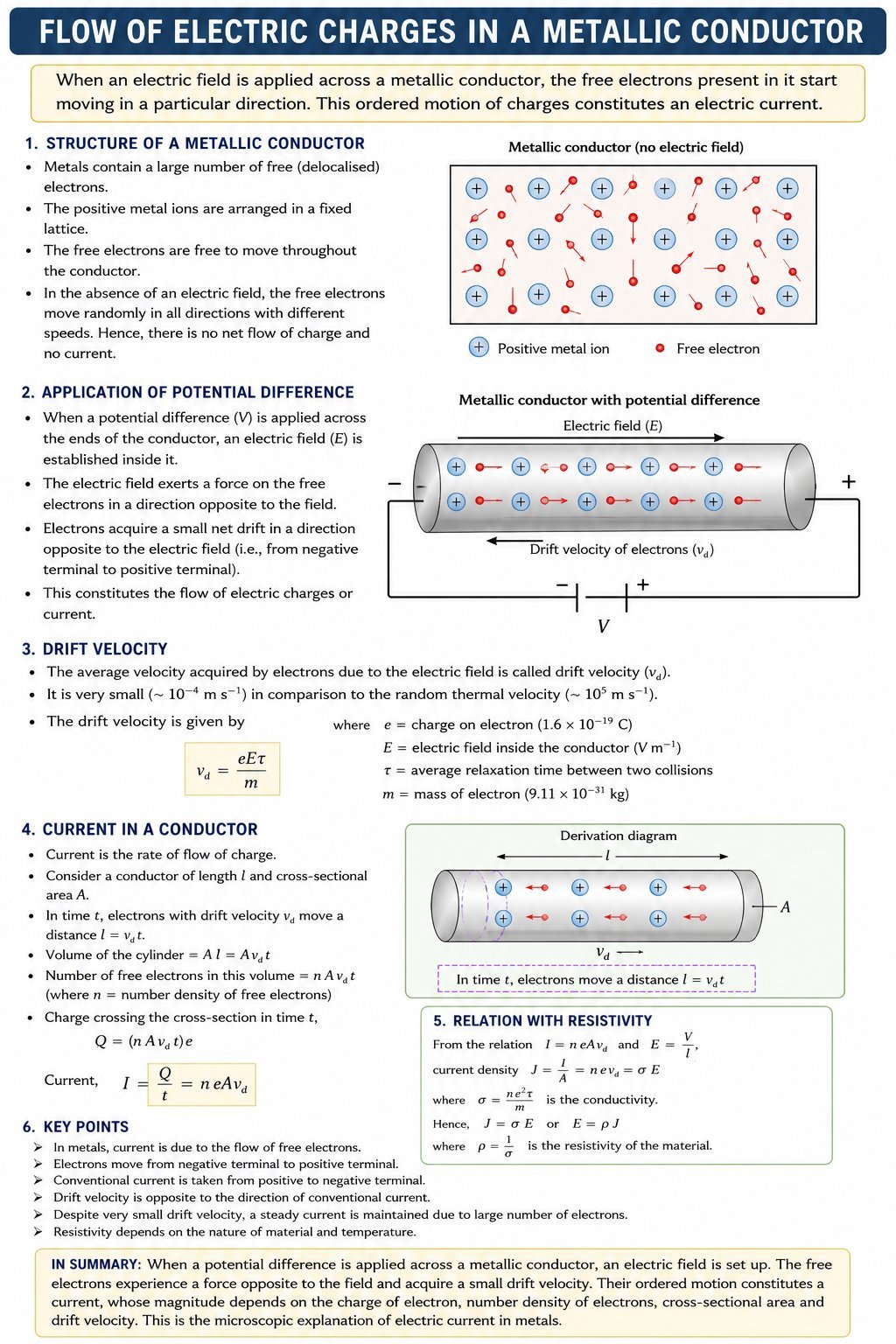
Topic 2 detailed poster · Structure of metals, drift velocity, current, resistivity
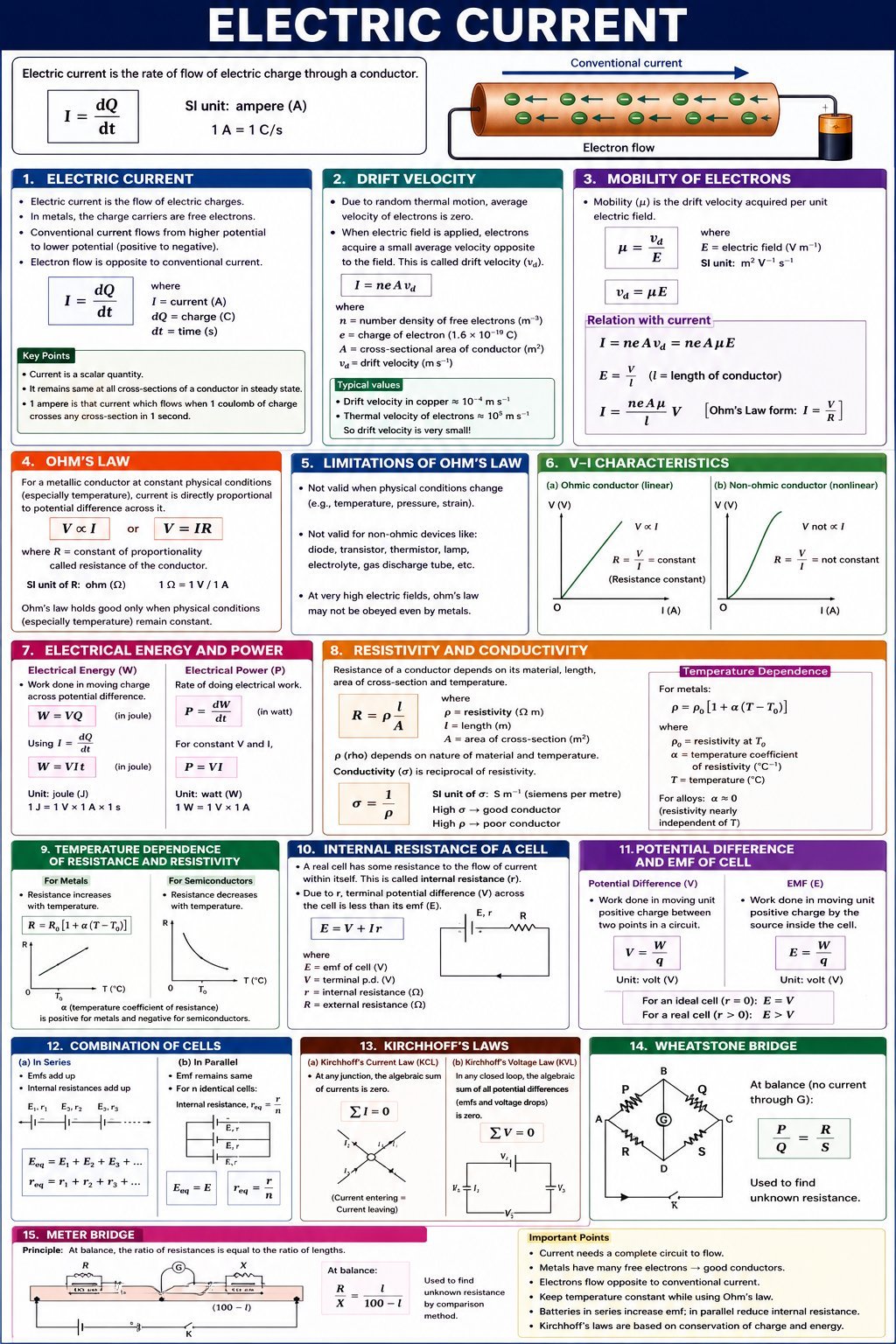
Master poster · all 15 topics of Unit-II for reference
From the random thermal dance of electrons inside a copper wire to the slow, ordered drift that produces a current — this topic is the microscopic story of what current actually is. Zero to hero.
A metallic conductor is a lattice of fixed positive ions through which countless free electrons are zipping around at very high thermal speeds (~10⁵ m/s) in random directions — with zero net flow. The moment we apply a potential difference across the wire, an electric field E appears inside it, and the field pushes the free electrons collectively in one direction (opposite to E).
This electron stampede gets interrupted again and again by collisions with the metal ions. The result is not a smooth glide, but a slow, jagged crawl on top of the wild thermal motion — the drift velocity vd, only about 10⁻⁴ m/s. The relation between drift and field is vd = eEτ/m, where τ is the average time between collisions (the relaxation time).
From this microscopic picture, current emerges as I = n e A vd, and the corresponding current density is J = ne vd = σE, where σ = ne²τ/m is the material's conductivity. This is the bridge from "electrons bumping around" to all the macroscopic circuit laws you already know.
Six micro-topics make up this lesson. Each is covered in detail in the theory section below.
Fixed lattice of positive ions; a "gas" of free electrons moving in random thermal directions with zero net flow.
Applying V sets up an electric field E = V/L inside the conductor. The field exerts force F = −eE on every free electron.
The small average velocity gained by electrons in the direction opposite to E. vd = eEτ/m; typical value ~10⁻⁴ m/s.
Average time between two successive collisions of a free electron with the lattice ions. Typical value ~10⁻¹⁴ s in copper.
Counting electrons that cross any section per second: I = n e A vd. The bridge to Topic 1's I = dQ/dt.
J = σE with σ = ne²τ/m; resistivity ρ = 1/σ depends on n, τ, and temperature. Preview of Ohm's law (Topic 4).
Before we open up the formulas, lock down these five basics. Each block is independent — read carefully and don't skip.
A piece of copper is not just "copper atoms". Atoms in a metal arrange themselves into a regular, fixed pattern called a crystal lattice. The atoms in this lattice have given up their outermost electrons; those electrons are now free to move through the whole metal. We picture the metal as positive ions (the lattice) bathed in a "sea" of free electrons.
The positive ions can vibrate slightly about their lattice positions, but they cannot wander. The free electrons CAN wander — and that wandering is what we are about to study.
Free electrons are not sitting still. At any temperature above absolute zero, they are in constant chaotic motion. Their average thermal speed at room temperature is huge — about 105 m/s (100 km per second!).
But this motion is completely random — every electron is going a different direction. The average velocity, vector-summed over all electrons, is exactly zero. So even though each individual electron is racing around, there is no net charge flow → no current.
An electric field E is just a region of space where every charge feels a push. For a charge q, the force on it is F = qE. For a negatively charged electron, the force is F = −eE — i.e., in the direction opposite to E.
When you connect a battery across a wire of length L, a uniform field of magnitude E = V/L appears inside the wire (V is the potential difference). Every free electron in the wire is now suddenly being pushed by this field.
As electrons try to drift along under the field, they keep bumping into the vibrating positive ions of the lattice. Each "collision" randomises the direction of that electron — it loses its drift and starts over.
The average time between two successive collisions for any given electron is called the relaxation time τ. In copper at room temperature, τ ≈ 10⁻¹⁴ seconds — incredibly short. So electrons get to drift freely only for about 10 femtoseconds before being knocked sideways.
Between two collisions, an electron is just a tiny particle with charge −e and mass m experiencing a force −eE. By Newton's second law:
a = F / m = eE / m (magnitude, in the direction opposite to E)
If the electron has just had a collision and started from "scratch" (random velocity, average zero), and it then accelerates for time τ before its next collision, the velocity gained is:
v_drift = a × τ = (eE/m) × τ = eEτ/m
That is the entire physics of drift velocity in one line. The full derivation below just polishes the argument.
If those five blocks feel solid — random thermal motion, the role of E and the −eE force, collisions with the lattice, relaxation time τ, and acceleration a = eE/m — then you are ready for the formal theory below.
Eight sub-sections build the full microscopic picture, step by step, from random thermal motion to the macroscopic current formula.
A metal like copper, silver, or aluminium is internally organised into a regular, three-dimensional pattern called a crystal lattice. At each lattice site sits a positive ion — an atom that has given up one or two of its outermost (valence) electrons. The ions can vibrate about their fixed positions, but they cannot translate through the metal.
The given-up valence electrons are not bound to any single atom; they are free to roam through the entire volume of the metal. We call them free electrons (or conduction electrons). The metal as a whole is electrically neutral because the total negative charge of the free electrons exactly cancels the total positive charge of the lattice ions.
In the absence of any applied field, the free electrons execute completely random thermal motion — every direction, every speed — so the average velocity over all electrons is zero. There is no current.
When a potential difference V is applied across the two ends of a conductor of length L, a uniform electric field is set up inside it:
This field exerts a force on every charged particle inside the wire. Since the free electrons are negatively charged, the force on each electron is:
So every free electron feels an identical force pushing it from the negative terminal end toward the positive terminal end of the source. The fixed lattice ions also feel a force (in the direction of E), but they cannot move — so they just vibrate a little harder.
Without a field, an electron's velocity over time averages to zero. With a field applied, this average is no longer zero — it picks up a tiny systematic component in the direction opposite to E. This small average velocity is called the drift velocity, written vd.
Formal definition: The drift velocity is the average velocity acquired by free electrons in a conductor when an external electric field is applied across it.
Two facts about drift velocity that must be memorised:
"If drift velocity is so slow, why does the bulb light up instantly when I flip the switch?" The answer: the electric field is set up across the wire at almost the speed of light. So every electron in the wire — including the one already inside the bulb filament — starts drifting almost immediately. The current carrier already at the bulb does the lighting; the new electron from the battery is still crawling.
A free electron does not drift smoothly. Between any two successive collisions with the lattice ions, the electron accelerates under the field — but the collision randomises its velocity, and it must start gaining drift speed all over again.
The average time between two successive collisions, taken across all free electrons, is called the relaxation time τ.
Two important behaviours of τ:
An electron of mass m feels a force F = −eE between collisions. Newton's second law gives its acceleration:
Just after a collision, the electron's velocity is random (average zero). It then accelerates for time τ before the next collision. So the velocity it has gained by the time of the next collision is, on average:
Two corollaries follow:
Now we count how many electrons cross a fixed cross-section of the wire per unit time. Consider a conductor of length L and uniform cross-sectional area A. Let n be the number density of free electrons (electrons per cubic metre).
In time t, every electron drifts a distance L = vd × t along the wire. So every electron currently within the section of volume A × vd × t will cross the right-hand cross-section of the wire in time t.
Number of free electrons in that volume = n × (A × vd × t) = n A vd t
Total charge crossing the section in time t = (number of electrons) × (charge per electron):
And by the definition of current:
This is the central result of the topic. It connects the macroscopic current I (which we measure with an ammeter) to the microscopic picture (n, e, A, vd).
Dividing both sides of I = neAvd by the area A:
Substituting vd = eEτ/m into J = nevd:
The quantity in brackets depends only on the material and its temperature — not on E. It is called the conductivity σ:
So we arrive at the microscopic form of Ohm's law:
The reciprocal of conductivity is the resistivity ρ:
We have just derived J = σE. Let us see how the familiar V = IR pops out:
For a uniform conductor of length L and area A: E = V/L, and J = I/A.
Substituting in J = σE: I/A = σ(V/L), which rearranges to:
So Ohm's law in its everyday form, V = IR, is a direct consequence of the microscopic picture — provided n and τ (and hence σ) are constants independent of E. (Which they are for metals at constant temperature.) This is the basis of Ohm's law and the starting point for Topic 4.
Every macroscopic circuit law you have used since Class 10 — V = IR, P = VI, Kirchhoff's rules — quietly assumes that electrons drift collectively under an applied field with vd ∝ E. The whole edifice rests on the eight lines of derivation above.
Two posters for this topic. Tap either to enlarge.
A full board-style derivation: from "metal at no field" to I = neAvd, in numbered steps.
Aim: Derive an expression for the electric current flowing through a metallic conductor of length L, cross-sectional area A, and free-electron density n, when a potential difference V is applied across it.
Step 1 — Electric field in the conductor. When a potential difference V is applied across a conductor of length L, the electric field inside is uniform with magnitude:
Step 2 — Force on each free electron. The field exerts a force F = −eE on every free electron (negative sign means the force is opposite to E):
Step 3 — Acceleration between collisions. Newton's second law gives:
Step 4 — Drift velocity acquired during one relaxation time. Just after a collision, the average electron velocity is zero. It then accelerates for time τ (the relaxation time) before the next collision:
Step 5 — Charge crossing a cross-section in time t. In time t, every electron moves a distance vdt along the wire. So the number of free electrons crossing any cross-section in time t equals the number contained in a volume A × vdt:
Each carries charge e, so the total charge is Q = N × e = n A vd t × e.
Step 6 — Current. By the definition I = Q/t:
Step 7 — Substituting vd. Combining with vd = eEτ/m and E = V/L gives:
Examiners often ask for this derivation in 5 marks. Always write all seven steps clearly, with a labelled diagram of a wire showing length L, area A, electric field E, and drift velocity vd. The diagram alone is worth 1 mark.
Two standard plots every student must be able to draw and interpret on sight.
From vd = (eτ/m) × E, drift velocity is directly proportional to E. The graph is a straight line passing through the origin, with slope eτ/m.
Since vd ∝ E ∝ V, the current I = neAvd is directly proportional to V. So I-V is a straight line through the origin, with slope 1/R.
From a V-I graph (V on y-axis, I on x-axis), the slope is the resistance R. From an I-V graph (I on y-axis, V on x-axis), the slope is 1/R (the conductance G).
Eight graded problems — from absolute basics to advanced. Each solution uses the 5-line format expected in board answers.
Six errors that cost marks every board exam. Learn them now.
Thermal velocity (~10⁵ m/s) is the chaotic random speed every electron has even without a field; drift velocity (~10⁻⁴ m/s) is the small average motion added by the field. They are not the same and not even close in magnitude.
The correct formula is vd = eEτ/m. The electron's charge e MUST appear in the numerator — that is the force per unit mass numerator, not just the field. Without e, the dimensions don't work.
Relaxation time τ is the average TIME between collisions. Mean free path λ is the average DISTANCE travelled between collisions. They are related by λ ≈ vthermal × τ. Don't confuse the two — board examiners ask for the difference.
Conventional current direction is OPPOSITE to drift velocity of electrons. Drift is from − to +, conventional current is from + to −. Always state this clearly in board answers.
Mobility μ = vd/E has SI unit m²/(V·s), not m/(V·s) or m²/V. Many students drop the 's' or write wrong units.
Slope of I-V graph (I on y-axis, V on x-axis) = 1/R, not R. Slope of V-I graph (V on y-axis, I on x-axis) = R. Check which variable is on which axis before computing.
Every term that may appear in board questions on this topic, with a one-sentence definition.
What the Punjab School Education Board typically asks on this topic and how to score full marks.
When asked to derive I = neAvd, always show: (1) a labelled diagram of a cylindrical wire with length L, area A, drift velocity vd marked; (2) the volume A × vd × t containing the electrons that cross the cross-section in time t; (3) the count nAvdt; (4) total charge Q = nAvdte; (5) I = Q/t. The diagram alone is worth 1 mark of the 5.
Many board questions ask "define" or "distinguish" between thermal velocity, drift velocity, and mobility. Memorise crisp one-line definitions for each (see glossary above), and give SI units in every answer. Definitions earn full marks even when calculations are wrong.
Board-pattern questions on this topic with model answers.
50 questions covering every sub-topic — structure of metals, drift velocity, relaxation time, current formula, conductivity. Tap an option to check.
Complete each statement with the correct word, phrase, or value.
Pair each item in Column A with the correct entry in Column B.
State whether each statement is true (T) or false (F).
1–2 mark questions with concise model answers.
3–5 mark questions requiring derivations, comparisons, or detailed explanations.
Each item has an Assertion (A) and a Reason (R). Choose: (a) Both true, R correct explanation of A. (b) Both true, R NOT correct explanation. (c) A true, R false. (d) A false, R true.
Three questions that apply the microscopic picture of current to situations from Kassoana, Ferozepur, and Punjab.
A submersible pump motor in a Kassoana farmhouse uses aluminium wire of cross-section 4 mm² to carry 12 A from the meter board to the well-head, 50 m away. (a) Calculate the drift velocity of electrons in this aluminium wire. (Take n = 6 × 10²⁸ /m³ for Al.) (b) How long would a single electron take to travel the 50 m from the switch to the motor? (c) Why does the motor start humming the instant the switch is closed even though the electron takes far longer to physically reach it? (Hint: think about the speed at which the electric field — not the electrons — propagates along the wire.)
During peak summer in Ferozepur, the temperature of overhead transmission wires rises from 25°C in the morning to ~65°C by afternoon. (a) Explain how this temperature rise affects the relaxation time τ of free electrons in the wire. (b) What does it do to the conductivity σ of the wire? (c) For the same voltage at the substation, will the current carried by a household feeder line increase or decrease as the day heats up? (Reasoning: lattice vibrations get worse with heat → more collisions → shorter τ.)
Suppose a thief replaces a 50 m stretch of copper distribution wire in a Punjab village with an aluminium wire of the SAME cross-sectional area. The two metals have free-electron densities nCu = 8.5 × 10²⁸ and nAl = 6.0 × 10²⁸ per m³. (a) For the same applied potential difference, which wire will carry more current — copper or aluminium — and why? (b) If a 5 A current was flowing originally, estimate the new current after the substitution (assume relaxation times are roughly similar). (c) Explain in one line why aluminium overhead lines are still used despite this, even though copper would carry more current. (Hint: cost and weight matter just as much as conductivity.)
Memorise this single table and you can answer 80% of board questions on this topic.
| Aspect | Key Point |
|---|---|
| Metal structure | Fixed positive ion lattice + free electrons; ions vibrate, electrons drift. |
| No field state | Electrons in random thermal motion; vthermal ~ 10⁵ m/s; net velocity = 0; no current. |
| Field applied | E = V/L set up inside; force on each electron F = −eE; electrons start drifting opposite to E. |
| Drift velocity | vd = eEτ/m; typically ~ 10⁻⁴ m/s in copper; very slow compared to thermal speed. |
| Relaxation time τ | Average time between successive collisions; ~ 10⁻¹⁴ s in copper. Decreases with temperature. |
| Mean free path λ | Average distance between collisions; λ ≈ vthermal × τ. |
| Mobility μ | μ = vd/E = eτ/m. SI unit m²V⁻¹s⁻¹. |
| Current formula | I = n e A vd. Derived by counting electrons in volume A·vd·t. |
| Current density | J = I/A = n e vd = σE. SI unit A/m². Vector along conventional current. |
| Conductivity | σ = ne²τ/m. SI unit S/m. Material property. |
| Resistivity | ρ = 1/σ = m/(ne²τ). SI unit Ω·m. |
| Macroscopic Ohm's law | V = IR follows from J = σE applied to a uniform wire: R = ρL/A. |
Every formula from this topic, with meaning and units.
| Formula | Meaning / Units |
|---|---|
| E = V / L | Uniform electric field inside a conductor of length L with potential difference V. Unit: V/m. |
| F = −eE | Force on each free electron (charge −e) in field E. Direction opposite to E. |
| a = eE / m | Acceleration of one electron between collisions. Unit: m/s². |
| vd = eEτ / m | Drift velocity of electrons. Unit: m/s. Direction opposite to E. |
| vd = μE | Drift velocity in terms of mobility. μ = eτ/m. |
| μ = eτ / m | Mobility of free electrons. SI unit: m²V⁻¹s⁻¹. |
| I = n e A vd | Macroscopic current in terms of microscopic quantities. Unit: ampere (A). |
| J = I / A = n e vd | Current density vector. SI unit: A/m². |
| J = σ E | Microscopic form of Ohm's law. |
| σ = n e² τ / m | Conductivity. SI unit: S/m or Ω⁻¹m⁻¹. |
| ρ = 1 / σ = m / (n e² τ) | Resistivity. SI unit: Ω·m. |
| V = I R, R = ρL/A | Macroscopic Ohm's law and its resistance formula. |
| λ ≈ vthermal × τ | Mean free path of electrons between collisions. |