From the flow of electrons in a copper wire to the precision of a meter bridge — this unit covers everything the Punjab Board (PSEB) asks about charges in motion. 15 topics, taught one at a time, with full notes, worked examples, and board-pattern practice.
All visual notes for Unit-II in one place. Tap the master poster to enlarge, or open the full image gallery to browse all chapter notes.
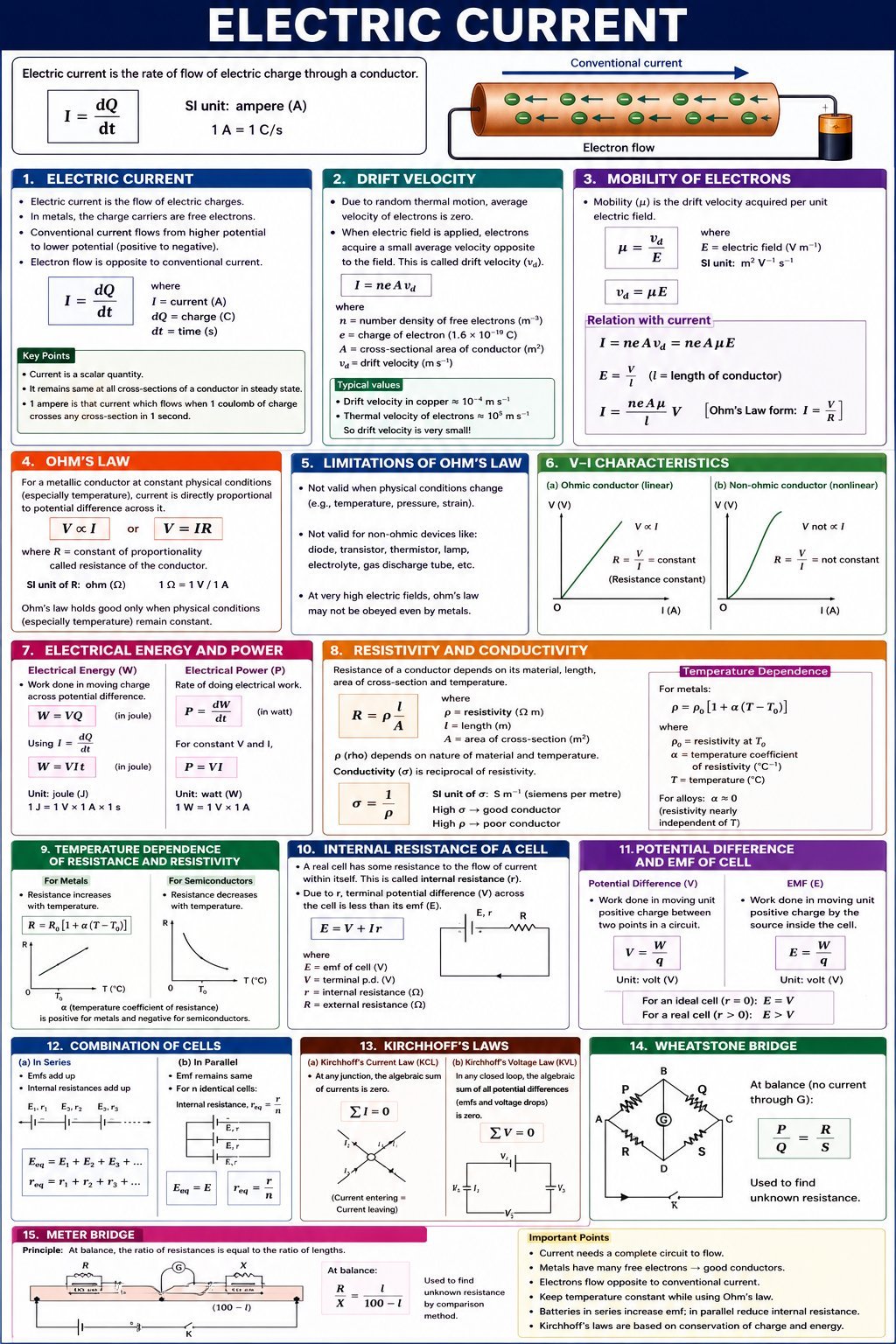
Topics build on each other. Read in order if you are encountering this material for the first time. Use the master notes above as you go.
Definition, mathematical form, conventional vs electron flow, charge quantization, scalar nature
Structure of metals, drift velocity, relaxation time, derivation of v_d = eEτ/m and I = neAv_d
Electron mobility μ = v_d/E, relation between current and drift velocity
V = IR statement, validity conditions, microscopic form J = σE
Linear vs non-linear conductors — metals, filament bulbs, junction diodes
When V ≠ IR — non-ohmic substances, directional dependence, history dependence
R = ρL/A, factors affecting resistance, resistors in series and parallel
ρ = m/(ne²τ), σ = 1/ρ, materials comparison, current density J
ρ vs T for metals, semiconductors, alloys; temperature coefficient α
P = VI = I²R = V²/R, kWh as commercial unit, Joule heating
Cell anatomy, terminal voltage V = ε − Ir, open vs closed circuit
Equivalent emf and resistance for combined cells, when to use each
Junction rule (charge conservation), loop rule (energy conservation), sign convention
Balanced condition P/Q = R/S, derivation using Kirchhoff's laws, applications
Practical setup, balance length method, finding unknown resistance