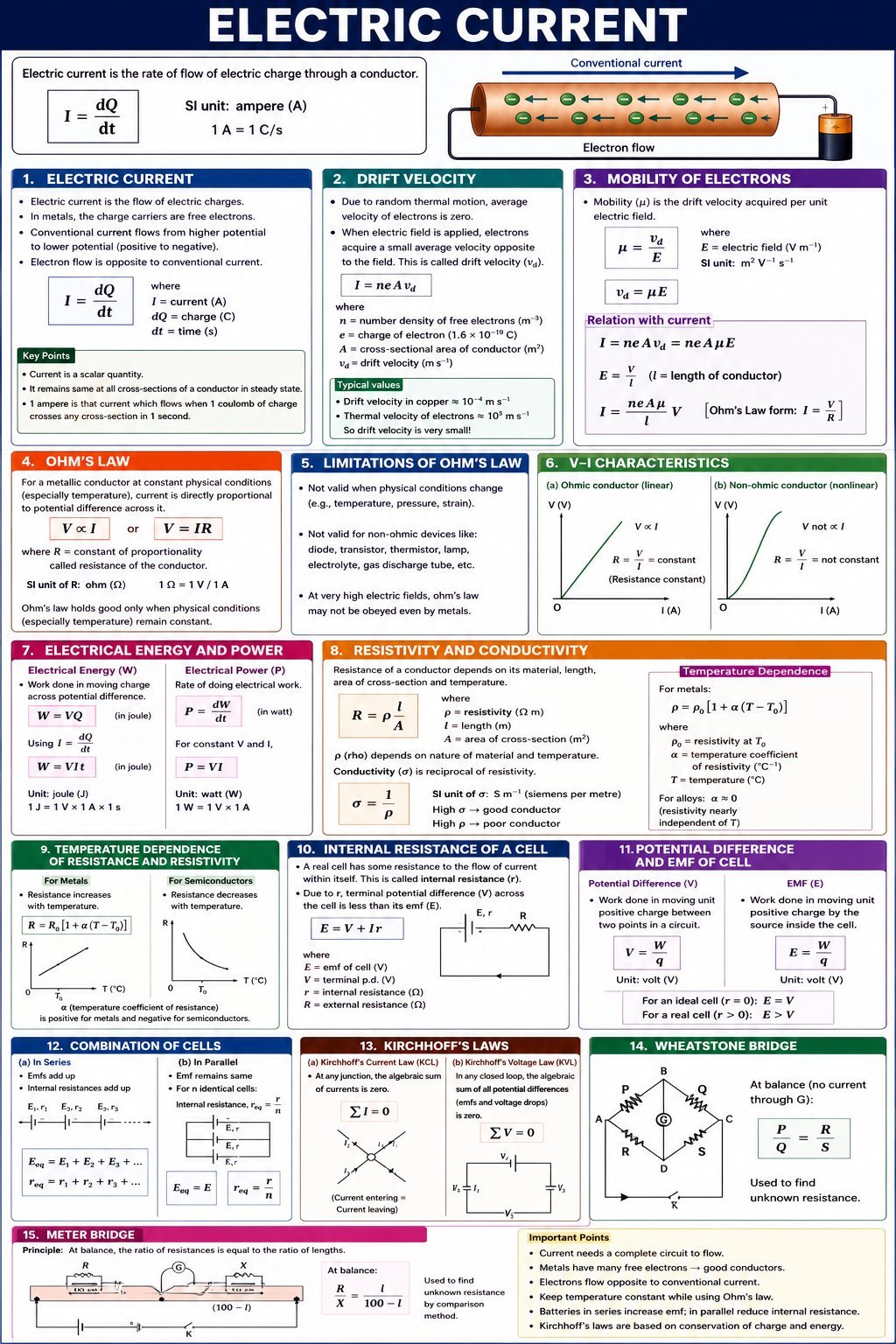
The directed rate of flow of electric charge through a conductor. From the absolute basics (what is charge?) all the way to the advanced microscopic picture — this page takes you from zero to hero on Topic 1.
Electric current is the directed rate of flow of electric charge through a conductor. In metals, mobile free electrons carry the charge, but by convention the current is taken in the direction positive charges would move — opposite to electron motion.
The fundamental definition is I = dQ/dt, with SI unit ampere (A), where 1 A = 1 C/s. For a steady current, charge versus time is a straight line through the origin with slope equal to the current. Current is a scalar quantity; its companion current density J = I/A is a vector.
This topic asks you to master the definition and derivations, name the charge carriers in each kind of conductor, distinguish conventional from electron flow, and solve graded numerical problems on charge, time, and number of electrons.
The five micro-topics this lesson breaks into. Each is covered in the theory section below.
Directed flow of charge; I = Q/t; SI unit ampere (A). Instantaneous form I = dQ/dt. Direction set by convention.
In metals: free electrons. In electrolytes & ionised gases: positive and negative ions. In semiconductors: electrons and holes.
Conventional current is the direction of positive charge flow (arrow from + to −). Electrons drift in the opposite direction.
J = I/A, SI unit A/m². A vector quantity in the direction of conventional current. Same as the direction of E in a conductor.
Preview: I = neAvd, where vd is drift speed. Detailed treatment in Topic 2 · Flow of Charges.
Before we touch any formula, make sure these five things are crystal clear. If any of them feels shaky, slow down and read it twice. The rest of the topic is built on top of these.
Some particles have it; some don't. Protons have a tiny positive charge (+e). Electrons have an equal tiny negative charge (−e). Neutrons have zero charge. A whole atom is neutral because the number of electrons matches the number of protons.
The SI unit of charge is the coulomb (C). One coulomb is huge — it equals the charge of about 6.25 × 10¹⁸ electrons. So when you see "0.5 C of charge flowed", picture trillions and trillions of electrons.
In metals like copper, aluminium, and silver, one or two electrons per atom are not tightly bound — they can wander freely through the metal. These are called free electrons (or conduction electrons). Metals are called conductors because of these.
In materials like rubber, glass, plastic, and wood, every electron is tightly bound to its atom. These are insulators — charge cannot flow through them in normal conditions.
In between sit semiconductors (silicon, germanium) — they have some free carriers but far fewer than metals.
If you connect a metal wire to the two terminals of a battery, the battery creates a tiny push — an electric field — inside the wire. The free electrons feel this push and start moving toward the positive terminal of the battery.
This continuous one-way motion of charges is what we call electric current. No battery, no push, no current.
Think of water in a pipe. If both ends are at the same height, water doesn't flow. If you raise one end, water flows downhill. A battery is like the pump or the height difference — it sets up the conditions for charges to flow.
For current to flow continuously, charges must have a complete path to travel along — from one terminal of the battery, through the wires and devices, back to the other terminal. This is called a closed circuit.
If there is any break in the path (an open switch, a broken wire), current stops immediately everywhere in the circuit. This is called an open circuit.
Why? Because charges cannot pile up at the broken end — they need to keep moving in a loop. The instant the loop breaks, the flow stops.
When we say "rate of flow", we mean "how much per second". If 10 coulombs flow past in 2 seconds, the rate is 10/2 = 5 coulombs per second. We call this 5 amperes.
So "current is the rate of flow of charge" is shorthand for: current measures how many coulombs of charge cross any cross-section of the wire every second. That single sentence is the heart of this entire topic.
If those five ideas feel solid, you are ready for the main theory below. If anything is fuzzy, read it one more time before moving on. From here it gets formal.
Read each sub-section in order. Eight blocks cover everything the Punjab Board can ask on this topic.
Electric current is the rate of flow of electric charge across any cross-section of a conductor. If a net charge ΔQ passes through a cross-section in time Δt, the average current is:
For a smoothly varying charge Q(t), the instantaneous current is the time derivative:
For a steady current (constant in time), both reduce to the simple form I = Q/t. The SI unit is the ampere (A), where 1 A = 1 C / 1 s.
Current is the flow of any charge carrier — not just electrons. The specific carriers depend on the conducting medium:
When asked to identify the charge carrier, always state both the carrier type and the material — for example: "In an electrolyte, the charge carriers are positive ions (cations) and negative ions (anions), which move in opposite directions."
This is the single most confusing point in this topic.
Before the electron was discovered (1897), Benjamin Franklin had already established the convention that current flows from the positive terminal of a battery to the negative terminal in the external circuit — this is the conventional current. Decades later we learned that the actual charge carriers in metals are negatively charged electrons, which flow in the opposite direction (from − to +).
Direction: from + terminal to − terminal (external circuit).
Sign: positive.
Used in: all problems, formulas, and circuit diagrams.
Direction: from − terminal to + terminal — opposite to conventional current.
Physically real: yes, but not used in equations.
Why: historical convention, kept for consistency.
Students often draw the current arrow in the same direction as electrons. Always draw conventional current from + to − in the external circuit — opposite to electron motion.
Electric current is a scalar describing the total rate of charge flow through a conductor. Current density J is the corresponding vector quantity that describes the flow at a point.
J is a vector in the direction of conventional current flow at that point (i.e., the direction in which positive charge would move under the local electric field). For a uniform conductor, the magnitude is just I/A and the direction is along the wire.
The relation between current density and electric field is given by the microscopic form of Ohm's law: J = σE, where σ is the conductivity of the material. (Covered in detail in Topic 8.)
In a steady-state series circuit with a uniform conductor, the current is the same at every cross-section. This follows directly from conservation of electric charge: charge cannot accumulate at any cross-section in steady state, so what flows in must flow out.
This is why an ammeter placed at any point in a series circuit shows the same reading — at the start of the wire, in the middle, or at the end. It is also why thin and thick wires in series carry the same current despite different cross-sections (and therefore have different current densities J = I/A).
Current has a direction — we draw arrows in circuit diagrams — so why is it called a scalar?
The answer: currents do not follow vector addition. Consider a junction where two wires meet at right angles, each carrying 1 A. By vector addition, the resultant would be √2 ≈ 1.41 A at 45°. But experimentally, the total current leaving the junction is exactly 1 + 1 = 2 A — algebraic addition, governed by Kirchhoff's junction rule.
So we have:
The direction of current is defined along the conductor, not in 3D space. That constraint is why current does not need vector addition.
A useful extension: if a charge Q is moving in a closed loop and completes f revolutions per second, the equivalent steady current is:
This form is used in atomic-model problems where an electron orbits a nucleus, and in cyclotron physics. It is the same definition I = Q/t applied to a periodic system.
So far we have defined current macroscopically — total charge crossing a section per unit time. There is a deeper expression in terms of what individual electrons are doing:
This formula is derived in detail in Topic 2 — Flow of Charges in a Metallic Conductor. For now, notice that current is set by:
Even though electrons drift extremely slowly, the wire carries useful current because n is enormous — there are trillions of trillions of free electrons in every cubic centimetre of metal.
Complete revision poster for all 15 topics of Unit-II. Section 1 covers this topic. Tap to enlarge.
Step-by-step derivation of the instantaneous form, with an applied numerical example.
Step 1 — Start from the definition. If a net charge ΔQ passes through a cross-section in time Δt, then the average current over that interval is:
Step 2 — Take the limit for instantaneous current. For a continuously varying charge Q(t), shrink the interval Δt to zero:
Step 3 — Apply to a numerical case. Suppose 720 C of charge passes through a wire in 4.00 s of steady flow.
So I = 180 A.
This is the basis of everything else in the unit. The instantaneous form I = dQ/dt is what lets us handle circuits where current changes with time — capacitor charging, AC circuits, transient discharges.
Two standard plots every student must recognise at sight.
For a constant current I, the charge accumulated since t = 0 is Q(t) = I·t + Q₀, which is a straight line on a Q-t plot.
On any I vs t graph, the area under the curve between time t₁ and t₂ gives the total charge transferred during that interval: Q = ∫I dt.
Eight graded problems — from absolute basics to advanced. Each solution uses the 5-line format expected in board answers: Given → To find → Formula → Calculation → Answer.
Six errors that cost marks in every board exam. Learn them in advance.
Forgetting that electrons are negative and so drawing the current arrow in the direction of electron motion. Always use conventional direction — current arrow from + to − in the external circuit.
Mixing amperes, coulombs, and seconds without checking. Always confirm: 1 A = 1 C/s. If t is given in minutes, multiply by 60 before using it in I = Q/t.
Writing Q = I/t instead of Q = I × t. Remember: I = ΔQ/Δt, so Q = I × t — never the other way around.
Thinking constant accumulated charge means zero current. Wrong direction — a flat Q-t line means no charge is being added per second, so I = dQ/dt = 0. A steady current shows up as a linearly rising Q-t line.
Trying to add currents using the vector triangle law at junctions. Current is a scalar — add algebraically (Kirchhoff's junction rule). Only current density J is a vector.
Saying current in an electrolyte is "only due to electrons" or "only due to ions". In an electrolyte both positive ions (cations) and negative ions (anions) move, and both contribute to current in the same direction.
Every term that may appear in board questions on this topic, with a one-sentence definition.
What the Punjab School Education Board typically asks on this topic and how to score full marks.
When asked to define electric current, always state three things together: (1) the qualitative definition ("rate of flow of charge"), (2) the formula (I = dQ/dt), and (3) the SI unit (ampere = 1 C/s). This earns full marks even for a 1-mark question.
Many board questions ask for a labelled diagram of conventional vs electron flow. Practice drawing a battery + wire loop + arrow for conventional current (from +) + arrow in opposite direction for electron flow. A clean diagram alone earns 1 mark in a 2-mark question.
Board-pattern questions on this topic with model answers. Compare your attempt with the model.
50 questions covering every sub-topic — definitions, numericals, conventional vs electron flow, charge carriers, current density, and junctions. Tap an option to check.
Complete each statement with the correct word, phrase, or value.
Pair each item in Column A with the correct entry in Column B.
State whether each statement is true (T) or false (F). Answers are shown beside each statement.
1–2 mark questions. Each comes with a concise model answer suitable for direct reproduction in board exams.
3–5 mark questions requiring derivations, comparisons, or detailed explanations.
Each item has an Assertion (A) and a Reason (R). Choose: (a) Both A and R are true, and R is correct explanation of A. (b) Both true, R is NOT correct explanation. (c) A true, R false. (d) A false, R true.
Three questions that take the basic concept of current and apply it to situations you see every day in Kassoana, Ferozepur, and across Punjab.
In a farmhouse near Kassoana, the main electricity supply line carries about 30 A during peak summer when the AC, fridge, fans, and tubewell motor all run together. (a) How many electrons flow through the main switch in 1 second? (b) If a stray cat brushes against an exposed live wire and 50 mA flows through its body for 0.2 seconds, how many electrons pass through? (c) Why is even a small current dangerous for living beings even though the total charge is tiny? (Hint: use Q = ne, then think about what electricity does to nerves and muscles)
During monsoon thunderstorms over Ferozepur, lightning can deliver up to 30,000 A in a flash that lasts only 30 microseconds. (a) Calculate the total charge transferred in one lightning bolt. (b) Compare this with the charge passing through a 60 W bulb in 1 hour (assume 220 V supply, so I = 60/220 = 0.27 A). (c) Why does lightning cause more damage than a bulb running for hours, when the total charge might be similar? (Think about: rate of energy transfer and what it does to materials)
Wheat farmers across Punjab rely on electric tubewells to pump groundwater. A typical 5 HP submersible pump draws a steady current of 7 A from a 415 V three-phase line. (a) How much charge does it move per second? (b) If the pump runs 6 hours per day during kharif season, how many electrons have flowed through it in 30 days? (c) Express the daily charge transferred in terms of multiples of "1 coulomb" — and explain why this is such a huge number but the bulb at your home still works on the same kind of charge. (Concept: charge per second is the rate; total charge over time is the integral)
The entire topic compressed into a single table. Memorise this and you can answer 80% of board questions on Electric Current.
| Aspect | Key Point |
|---|---|
| Definition | Rate of flow of charge: I = ΔQ/Δt. SI unit: ampere (A); 1 A = 1 C/s. |
| Instantaneous form | I = dQ/dt for variable charge flow. |
| Charge carriers | Metals: free electrons. Electrolytes: cations and anions. Semiconductors: electrons and holes. Plasma: electrons and ions. |
| Direction | Conventional current: from + to − (direction positive charge would move). Electron flow: opposite, from − to +. |
| Type of quantity | Scalar. Adds algebraically at junctions (Kirchhoff's rule). Current density J = I/A is the corresponding vector. |
| Continuity | In steady state, current is the same at all cross-sections of a uniform series conductor. |
| Q vs t graph | Straight line for steady current; slope = I. |
| I vs t graph | Horizontal for DC; sinusoidal for AC; exponential decay for charging/discharging capacitor. |
| Microscopic form | I = neAvd (covered in detail in Topic 2 — Flow of Charges). |
| Orbital form | I = Q × f for a charge revolving with frequency f (Bohr atom, cyclotron). |
| Charge quantization | Q = n × e, where n is an integer and e = 1.6 × 10⁻¹⁹ C. |
| Common mistakes | Reversing direction; mixing units; writing Q = I/t; treating I as vector; ignoring ion contribution in electrolytes. |
Every formula from this topic, with meaning and units. Print this page and stick on your study wall.
| Formula | Meaning / Units |
|---|---|
| I = Q/t | Steady current = charge per unit time. SI unit: ampere (A). |
| I = dQ/dt | Instantaneous current for time-varying charge. Unit: ampere. |
| Q = ∫ I dt | Total charge from variable current. Integrate I(t) between time limits. |
| Q = I × t | Charge transferred in time t at steady current I. Unit: coulomb (C). |
| Q = n × e | Charge quantization: n electrons × elementary charge (e = 1.6 × 10⁻¹⁹ C). |
| J = I / A | Current density (vector). SI unit: A/m². |
| I = neAvd | Microscopic form using drift velocity (Topic 2). |
| I = Q × f = Q / T | Equivalent current of a charge revolving with frequency f (used in Bohr atom). |
| 1 A = 1 C/s | SI definition of ampere. |
| [I] = [A] | Dimensional formula of current. Current is a base SI quantity. |